For most rubble removal jobs the answer is one size smaller than people expect, because rubble runs out of weight long before it runs out of room. Here is how we size skip bins for work around Paarl, Wellington, Klapmuts and Franschhoek, what moves the price, and the local rules that decide where a bin is allowed to stand.
The short answer
A 6m³ builders skip suits most renovations. A 4m³ suits a single room or a small landscaping job. Go to 8m³ only when the waste is bulky and light, and drop to 2m³ or 4m³ when it is rubble.
| Size | Roughly equal to | Typical job |
|---|---|---|
| 2m³ mini | 1 bakkie load, 20 to 25 wheelbarrows | Garage clear-out, garden cuttings, one room of junk |
| 4m³ midi | 2 bakkie loads, 35 to 45 wheelbarrows | Bathroom strip-out, small landscaping job, office clear-out |
| 6m³ builders | 3 bakkie loads, 60 to 70 wheelbarrows | Kitchen or bathroom renovation, mixed building waste |
| 8m³ large | 4 bakkie loads, 80 to 90 wheelbarrows | Whole-property clear-out, bulky light waste, shopfitting strip |
Those equivalents assume a bakkie bed filled level, not heaped. If you are clearing concrete, brick or soil, start one size down from what the volume suggests and read the next section before you book.
Why rubble fills a skip by weight, not volume
A loaded skip has to leave your site on a trailer and travel a public road legally. That puts two limits on it: the rim, and the axle.
Loaded level with the rim is the working limit. Anything standing proud of the sides cannot be sheeted, so it cannot be moved, and the driver will either level it on site or leave it. Weight arrives well before that point with dense material. Wet building sand, broken concrete and clay soil are heavy enough that a 6m³ skip filled halfway can weigh more than the same skip packed to the rim with packaging and offcuts.
The practical rule we work to on site is simple. Heavy material goes in a smaller skip, swapped more often. Light bulky material goes in a bigger one, collected once. Two swaps of a 4m³ on rubble cost less than an 8m³ you were never going to fill safely.
How to size by material
Most sizing mistakes come from thinking in rooms. Think in materials instead, because that is what decides both the size and the disposal cost.
| What you are clearing | Size | Collected |
|---|---|---|
| Rubble, concrete, brick, soil | 4m³ | Swapped as it fills |
| Mixed building waste | 6m³ | Once or swapped |
| Garden and green waste | 6m³ to 8m³ | Once |
| Whole-property clear-out | 8m³ | Once |
| Cardboard, film, glass | Cage, not a skip | On a schedule |
| Food waste | Rocker bin | Fixed schedule |
Rubble, concrete, brick and soil
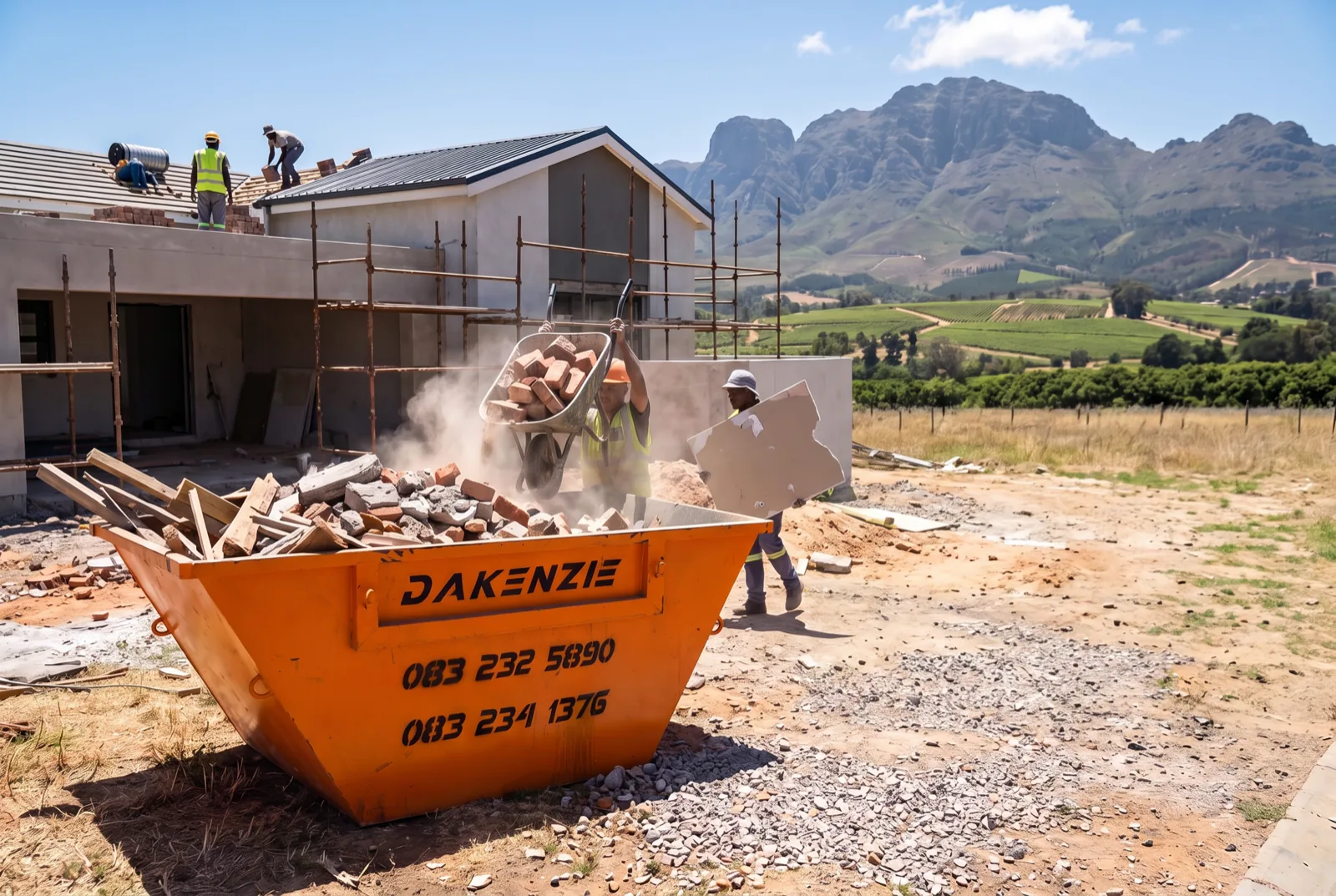
Dense and heavy. Book a 4m³ and swap it as needed. Keep it clean and it stays in the cheapest disposal class, which matters more than the hire rate on a big job.
Mixed building waste
Timber, board, offcuts, packaging and some rubble together. This is where the 6m³ earns its keep, and it is the size we drop most often on renovations around Paarl and Wellington.
Garden and green waste
Bulks up fast and weighs little once it is loose. One 6m³ or 8m³ collected once beats two loads of a smaller skip on cost.
Cardboard, plastic film and glass
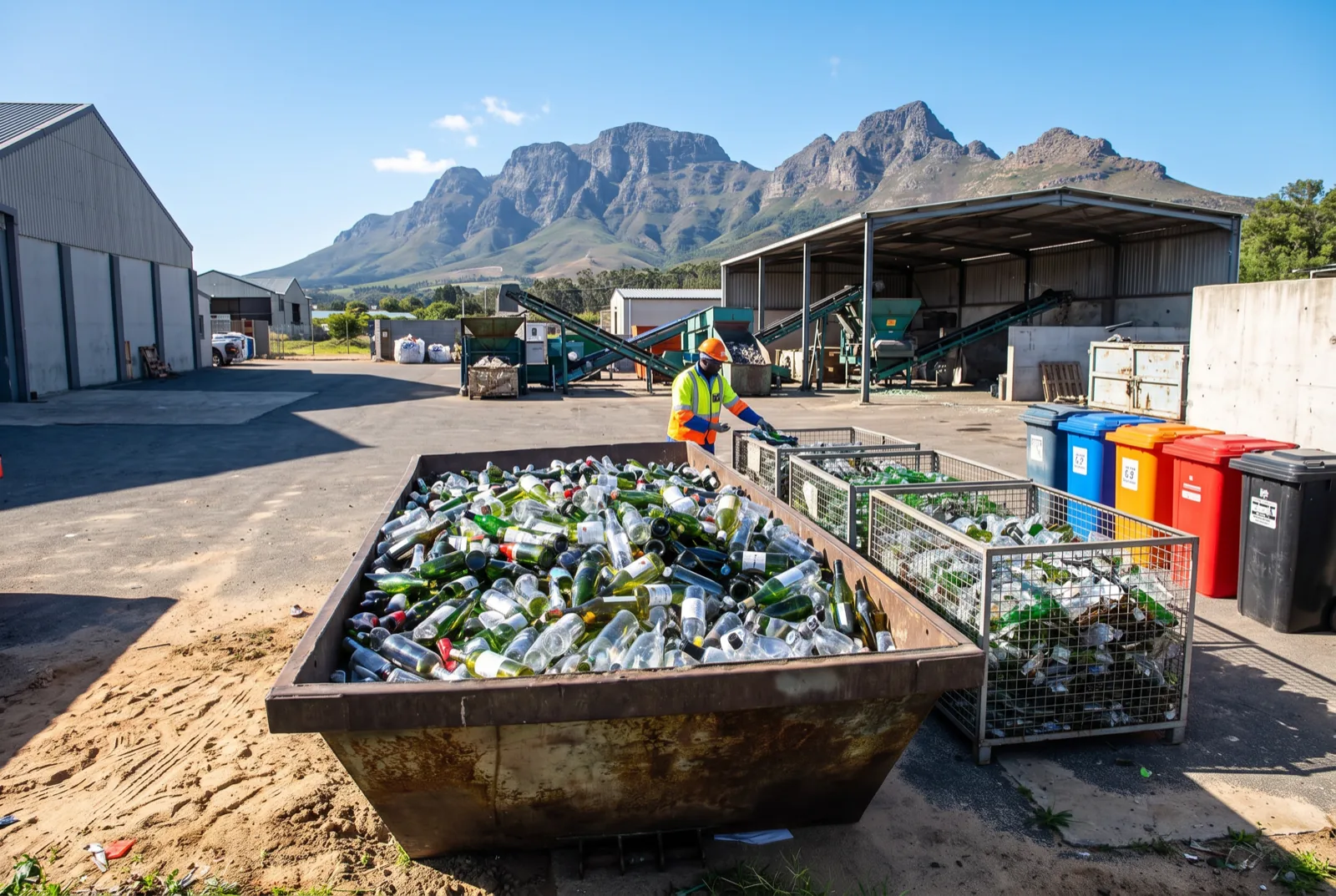
A skip is the wrong container. These go into cages or straight to our balers, where separated material has resale value instead of a disposal cost. Our waste and recycling division handles that side, and a business filling one every week will pay less on a scheduled cage than on repeat skip hire.
Food waste
Rocker bins on a fixed collection schedule, not a skip. Restaurants and tasting rooms need the frequency more than the volume.
What moves the price of a skip bin?
Two skips of the same size can be quoted differently. Size matters less than what goes in the bin and how often it has to move.
Weight and contamination do most of the work. Clean rubble takes the cheapest disposal route. The same bin with timber, plastic or metal mixed through it is a different class of waste at the landfill, and that difference lands in the quote. A 4m³ collected twice can come in under an 8m³ collected once, or over it, depending entirely on the material.
Three smaller things move the number as well, and the first of them is simply where you are. Prices for work in town are set out on our skip hire in Paarl page.
- Distance from Paarl, Wellington, Klapmuts or Franschhoek, and whether the placement needs a smaller trailer to reach it
- How long the bin stands on site, since a weekend clear-out and a month-long job are not the same booking
- Wasted trips, because a blocked driveway or a bin loaded above the rim means a second visit
We quote on the job rather than off a rate card, because the honest answer depends on the material and the access. Describe both and the number stops moving. The quote holds unless the waste turns out to be something other than what was described.
Where will the skip stand?
Size is half the question. The other half is whether we can place it where you want it and whether it is allowed to be there.
- Our skip-loader trailers reach driveways, courtyards and narrow farm roads that a full-size skip truck cannot. Tell us about the access and we will confirm what fits before the day.
- Clear the spot first, including vehicles. A blocked placement area is the most common reason a delivery turns into a wasted trip.
- Think about the surface. Skips are heavy on paving, and we cannot see irrigation or drain covers under a lawn.
If the skip has to stand on a public road or pavement instead of your own property, that needs permission from the municipality, and getting it is the customer's responsibility unless we have agreed otherwise in writing. A container on a public road also needs reflective chevron tape so it is visible at night. Unauthorised placement carries fines that typically run from R500 to over R2,000, plus an instruction to remove it immediately.
On a private driveway or yard, none of that applies. Most of our Winelands work is placed on the customer's own property.
What cannot go in a skip
Some material is classed as hazardous under the National Environmental Management: Waste Act 59 of 2008 and cannot go to a general landfill at any price. Tell us before the skip arrives and we will route it through a licensed facility instead.
- Asbestos in any form, including old roof sheeting
- Chemicals, solvents, paint, oil and fuel
- Gas bottles, aerosols and anything pressurised
- Batteries and electronic waste
- Tyres
- Medical or clinical waste
Finding any of it in a collected skip means either a refused collection or the cost of separating and disposing of it lawfully. Neither is a conversation anyone enjoys having on a Friday afternoon.
What happens to it after collection
Where the load goes decides part of what it costs, which is why we sort before anything reaches a landfill. Recyclables are separated and baled on our X25 and H20 balers. The rest goes to the correct facility.
Locally that facility is specific. Drakenstein accepts builders rubble at the Wellington landfill, and it has to be clean: sand, stone, soil, and pieces of concrete or brick under 100mm, with no iron, plastic or wood mixed in. Loads that fail that test are charged by weight, around R262.50 a ton at the time of writing. Keeping timber and packaging out of a rubble skip is worth real money on a demolition job, not just good practice.
One thing worth knowing before you hire anything: Drakenstein residents can drop one bakkie or trailer load of up to a ton at the Wellington landfill or the Paarl transfer station each month at no charge, with a current municipal account and proof of where the waste came from. For a genuinely small clear-out, that may be all you need. We would rather tell you that than sell you a skip you can do without.
A two-minute sizing check
- Name the heaviest material going in. If it is concrete, brick or soil, size down.
- Estimate in bakkie loads, not rooms, and assume level, not heaped.
- Decide whether it is one clear-out or an ongoing job. Ongoing usually means a smaller container collected on a schedule.
- Check the placement spot for access, surface and whether it is on your property.
- Separate anything hazardous before the skip arrives.
Run through those five and you will land on the right size more often than not. Or skip the arithmetic, describe the job and call us on +27 83 232 5890 and we will tell you what we would send.
Questions we get asked
How much does it cost to hire a skip bin?
It depends on the size, what goes in it, how far it travels and how long you keep it. Clean rubble is the cheapest load to dispose of; a mixed load costs more at the landfill, and that shows up in the quote. Tell us the material and the address and we will give you a firm number rather than a range.
Is it cheaper to hire one big skip or swap a smaller one?
For rubble, swapping a 4m³ works out cheaper, because you would hit the weight limit in a larger bin long before you filled it. For garden waste, packaging and other bulky light material, one larger bin collected once normally wins.
What size skip do I need for a bathroom renovation?
A 4m³ skip covers most bathroom strip-outs. Move up to a 6m³ if you are lifting floor screed or a lot of wall tile, since both are heavier and bulkier than they look coming off the wall.
How many wheelbarrows fit in a 6m³ skip?
Between 60 and 70 standard builder's wheelbarrow loads, or roughly three level bakkie loads. With rubble you will usually reach the weight limit before you reach 70.
Can I put soil and rubble in the same skip?
Yes, and it is the cheapest way to dispose of both, provided the load stays clean. Sand, stone, soil, concrete and brick can travel together. Adding timber, plastic or metal moves the whole load out of the clean rubble class and into a charged one.
Do I need a permit to put a skip on the road?
On a public road or pavement, yes: the municipality has to give permission, and the container needs reflective chevron tape. On your own driveway or yard, no permit is needed. Unauthorised placement on public land risks a fine and immediate removal.
How long can I keep the skip?
From a weekend to a standing weekly collection. Once-off hire suits a clear-out; if you are generating waste every week, a scheduled swap usually works out cheaper than repeat once-off hires.
Can I hire a skip on its own, without other services?
Yes. Skips, mesh cages and rocker bins are all available for standalone hire, and so are our side trailers if you have your own driver.
What happens if I fill it higher than the sides?
We cannot legally transport it, so it will either be levelled on site or left for you to level. If you are running out of room, call for a swap rather than loading above the rim.
Still not sure what to book? Describe the job and we will tell you what we would send. See skip and cage hire for what is available, or skip hire in Paarl if the job is in town and you want prices and same-day delivery. If the waste is more ongoing than one-off, waste and recycling is usually the better fit, and we also run transport and haulage if something needs moving instead of clearing.